




כ״ה טבת ה׳תשפ״ו | January 13, 2026
Graphologist’s Fascinating Attempt to Uncover Alter Rebbe’s Inner World
For the Alter Rebbe’s 150th yahrtzeit, Israeli President Zalman Shazar commissioned a world-renowned graphologist to analyze the Alter Rebbe’s handwriting from an authentic manuscript provided by the Rebbe. The Rebbe reviewed the study, approved its publication, and expressed amazement at its accuracy. The results are presented here.
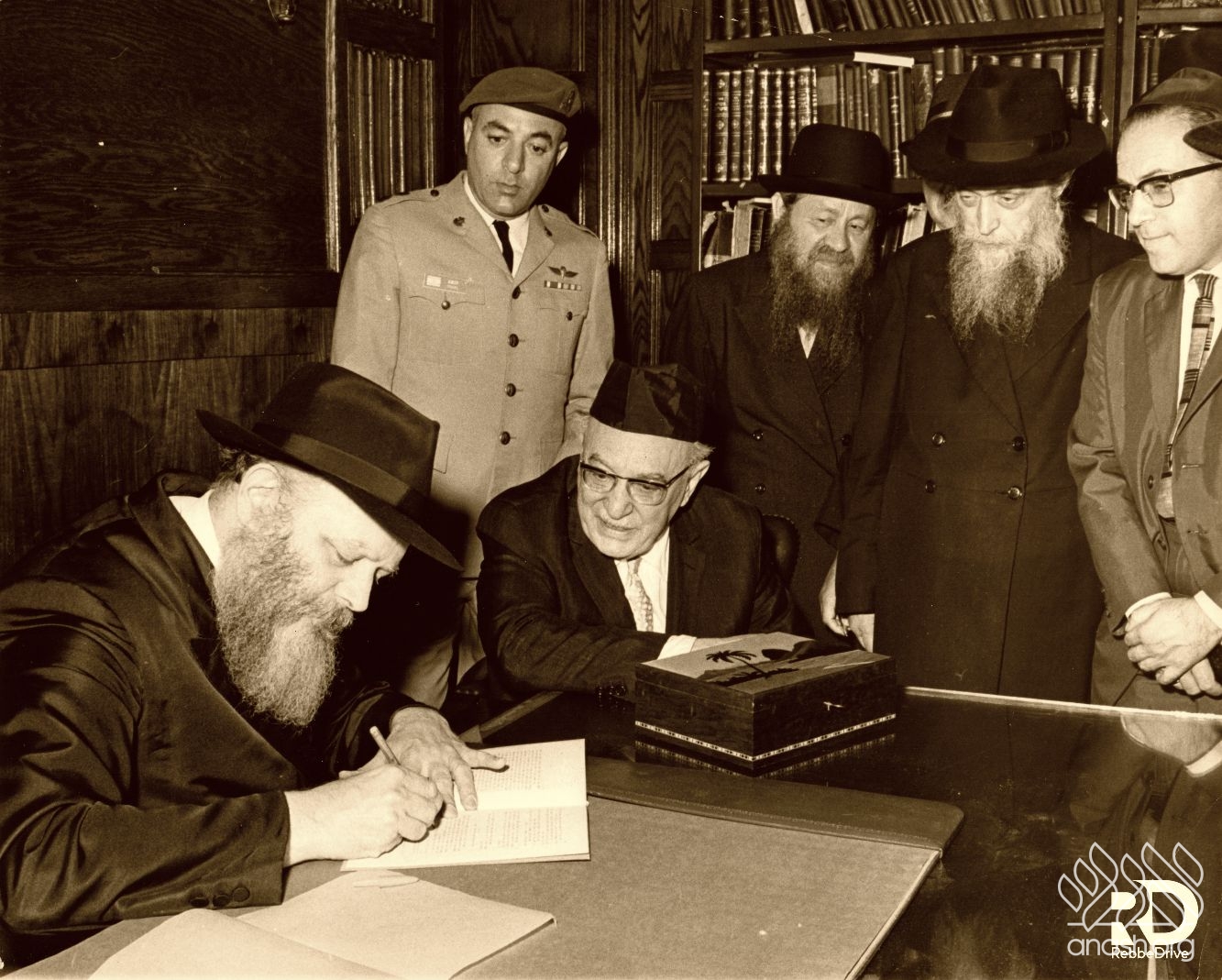
In honor of the 150th yahrtzeit of the Alter Rebbe (5573–5723), the Rebbe initiated a major shturem to mark this momentous milestone. In this spirit, a suggestion was raised to produce a commemorative journal containing academic essays about the Alter Rebbe, submitted by the finest writers and thinkers of the time.
The idea originated from the Chassidus club, hosted by President Zalman Shazar, which brought together poets, professors, and Jewish intellectuals. When Mr. Shazar wrote to the Rebbe about the proposal, the Rebbe was very pleased and became closely involved in the project.
The commemorative journal, called Sefer HaKan, included fourteen scholarly essays by contributors from a wide range of backgrounds, each focusing on a different aspect of the Alter Rebbe’s life, personality, and teachings.
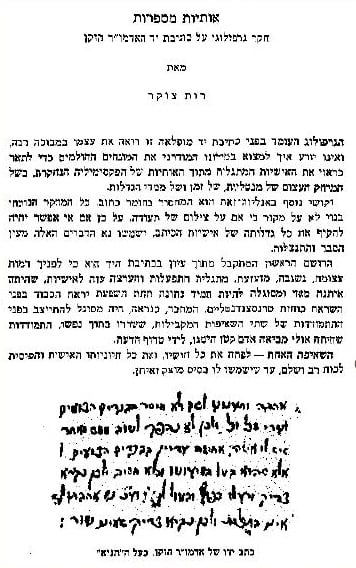
One fascinating appendix to the journal was a graphological study of the Alter Rebbe’s handwriting, which claims to be able to gain insight into a person’s character, personality, and emotional tendencies.
A world-renowned graphologist was hired by President Shazar, himself named after the Alter Rebbe, who, as Shazar notes, “did not know any Hebrew at all… she knew nothing of the Alter Rebbe, neither his history nor the significance of his role in the Jewish world.”
The study was conducted on the basis of a photograph of an authentic manuscript, which President Shazar received for this purpose from the Rebbe. According to Shazar, “the Rebbe read the analysis and agreed to its publication.”
In a letter to Mr. Shazar dated 5719, the Rebbe expressed his amazement at the findings, writing: “Had I not known that the graphologist was entirely unfamiliar with the Alter Rebbe, and had I not known you personally, I would not have believed that this could be possible.”
The Rebbe also expressed regret that he had not suggested using a different sample of the Alter Rebbe’s handwriting, from which even greater insight into the character of the Alter Rebbe might have been drawn.
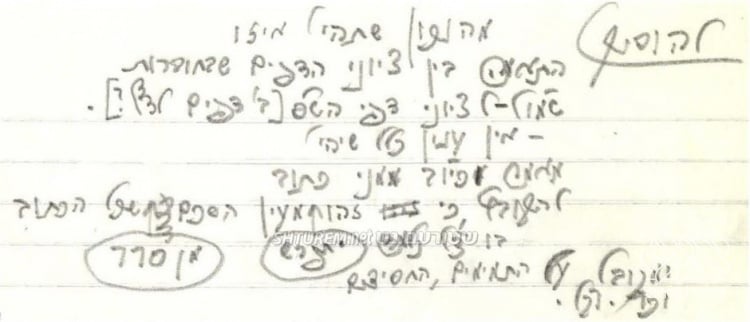
It is important to note the Rebbe’s response to the editor of the journal, Rabbi Adin Even-Israel, who asked that the Rebbe write an introduction to Sefer HaKen. The Rebbe replied:
“There is no reason at all for me to contribute an article or anything similar to this collection, since that would be interpreted as a form of endorsement from 770, implying that everything written in it must be studied and accepted by the temimim, the chassidim, and others. This is self-evident.”
Presented here is the graphological analysis in its entirety, together with the brief introduction written by Mr. Shazar.
*
Mrs. Ruth Zucker, the author of this graphological analysis of the Alter Rebbe’s handwriting, is a researcher whose opinion has served as a basis for many court rulings in Israel. She learned the theory of graphology from Professor G. A. Magnat, president of the Association of Graphologists in Geneva, Switzerland, and some of her graphological studies on writers were published in academic journals, earning her much renown.
When I asked her to conduct this graphological analysis, she did not know any Hebrew at all. She could only recognize the shape of the letters, but did not understand the meaning of the words. I also evaluated her carefully and ascertained that she knew nothing of the Alter Rebbe, neither his history nor about the significance of his role in the Jewish world. All of her writing was based only on the analysis of the letters and she only related what she was told by the letters.
The research was done on the basis of a photograph of an authentic manuscript, which I received for this purpose from the Lubavitcher Rebbe, who also read this analysis and agreed to publish it.
When I translated her research from English to Hebrew, I did not try to express her ideas in terminologies used in Chassidic literature, rather I was careful that the terms retain their basic meaning, as she used them.
Shneur Zalman Shazar
*
The Graphological Analysis
The graphologist who stands before this extraordinary manuscript finds himself in great difficulty. He does not know how to locate, within his modern vocabulary, terms adequate to describe the personality revealed by the letters of the manuscript under examination. The gulf in mentality, historical distance, and sheer magnitude presents a formidable challenge.
An additional difficulty lies in the scarcity of material. This entire study is based not on an original document, but on a photographic reproduction. It is therefore impossible to encompass the full greatness of the writer’s personality. These remarks should be taken as both explanation and apology.
The first impression conveyed by the handwriting is that one stands before a towering, exalted, and deeply stirring figure. What emerges is an intense admiration for a personality of immense inner strength, one capable of remaining constantly under the influence of reverence for transcendent forces. The author appears to have been able to withstand the tension between two parallel inner drives, a tension that might have driven a lesser individual to mental collapse.
The first drive was to develop all his senses and his physical and personal vitality to their fullest strength, creating a firm and stable foundation.
The second drive was to elevate, without compromise, all the forces emerging from that foundation and dedicate them entirely to the spiritual. He sought to lift the raw power of the senses from their “lower natural state” and transform them into a refined enthusiasm, fully subordinated to spiritual aims.
Through this process of sublimation, he did not detach himself from earthly weight or from responsibility toward the material world. Rather, he seems to have attained inner vision through the awakening of passionate desires that lifted him above the earthly level in which they originated. Yet he never forgot their source, and accepted it with noble simplicity and humility.
He was humble enough to acknowledge that source, and bold and dynamic enough to rise beyond it and leave it behind. He returned to it naturally, as one returns to a root, not out of a sense of limitation or failure, but without any sense of descent.
The irrational enthusiasm revealed in the handwriting, which reflects a complete devotion of the self to spiritual work, was apparently always balanced by powerful rational thought and by a strict, unsparing capacity for judgment.
He appears to have lived under a severe inner command, almost a supreme order, to bring transcendent contemplation down to earth. This contemplation was not bestowed upon him freely from above, but was conquered through immense inner struggle. He felt obligated to give it concrete, binding, and practical expression, out of love for humanity and for the entire universe.
The handwriting testifies to a constant warmth of interest, which likely drove him to seek and discover the deepest possible connection between humanity – indeed, the entire cosmos – and his own contemplation of the exalted world. From this successful synthesis emerged a quiet, firm pride, inseparably bound with humility and an absence of affectation. His inclination toward concreteness led him to strive for systematic and precise understanding of the world, without fear of contradiction or mystery, and with the courage to confront even that which defies explanation.
When he encountered something he could not explain, he accepted it humbly as instruction from above, without rebellion. Ultimately, he placed greater trust in his humility than in his wisdom.
Yet it is quite possible that his strong leadership capacity prevented him from appearing publicly as merely humble. He aspired to be, increasingly so, a pillar of support for his community. The handwriting reflects absolute solidity and uprightness that enabled him to fulfill this role.
More than a desire to guide others, he possessed a powerful instinct to protect them. Both tendencies were strong and deeply ingrained. He felt a fateful command to stand firm as a living example for those loyal to him. And because he was an active personality, the mission of being an example could not remain passive; it necessarily bore tangible fruit in counsel, generous assistance, and active communal leadership.
At times, he likely struggled inwardly with the desire to descend to the level of those around him. At other times, he yielded to this impulse with kindness and expressed it through a uniquely poetic gentleness. Yet always, only in order to return immediately to his infinite distance. This withdrawal resembled the dive of a deep-sea diver into an abyss illuminated by flashes of revelation and boundless joy.
His drive toward people did not mean full identification with them. He remained, in some sense, profoundly separate, yet filled with love and understanding for others. His love made him endlessly patient with people, while utterly unsparing toward himself.
Toward himself he lived strictly by self-imposed laws, formed through rigorous and often harsh inner examination. He adhered to them with characteristic persistence and with the same initial, powerful enthusiasm.
His handwriting shows that in all his inner investigations he imposed strict supervision over his fertile imagination. The vitality and creativity of his imagination – qualities that in a lesser person might have led to artistic or literary expression – forced him to treat his visions with severe restraint.
He possessed a strong poetic capacity. Very rarely, he permitted himself moments of gentle, soothing mood. Yet he chose instead a path of sacred asceticism, devoting himself to it almost without interruption. It is difficult to determine, given the limited material, whether his endless striving for truth arose from inner longing or from an external divine command.
Most likely, both were true at different stages of his life. At times he was driven by yearning for perfection; at others, by an uncompromising inner decree that forbade him from settling for anything less than the highest spiritual attainment possible.
He was filled with a powerful aspiration toward positive faith, yet he was never quick to believe and had no inclination toward naïve optimism. More than most people, he perceived the dark side of human nature and refused to avert his eyes from reality. Nothing was further from him than credulity. He weighed good and evil against one another, and in this struggle he accepted every test and confrontation. His immense vitality empowered the good, while his integrity, seriousness, and honesty overcame the dark.
This struggle was not theoretical. It was a command not to accept evil, but to refine and elevate reality and illuminate it. This principle led him to attempt what often seemed impossible. Sustained by the conviction that he lived under the guardianship of a supreme law, which he accepted joyfully and served faithfully, he was protected from skepticism. His handwriting conveys a deep sense of security under a higher order, one comprehensible to his encompassing intellect.
Yet what caused this constant inner struggle? It seems to have arisen from his relentless effort to understand even what lay beyond rational comprehension. He pursued insight with all the power of his reason, distrusting imagination and blind faith alike, striving always to penetrate to the core essence of ideas.
Despite traces of struggle, the handwriting reveals strong inner discipline, which gradually replaced conflict with maturity. What was once passionate motion became acceptance of responsibility and productive creation; restlessness gave way to understanding, quiet attentiveness, love of tradition, and patient construction upon firm foundations.
In his mature personality, the inner battle subsided, though resistance to external opposition remained. His strength prevented him from yielding to the outside world.
 COMMENTS


Is the original English or a translation of the Hebrew Translation?
this is not the original English. It should also be noted that the ksav yad of the Alter Rebbe which was attached to the article in the sefer hakan is actually not the ksav yad of the Alter Rebbe and is probably for illustration purposes only and definitely not the one that was used.
I am not arguing your statement, but I don’t think it is right to say so without noting what was assumed and written about it.
The Ksav Yad pictured (printed in every tanya) is the Ksav Yad of the Alter Rebbe, read the Rebbe’s, the Frierdiker Rebbe’s, and the Rebbe Rashab’s statements on this, which are also printed in every Tanya (and the Rebbe Maharash’s opinion – as noted there).
Indeed, this was not the ksav yad that was given to the graphologist. IIRC they used the ksav yad kodesh printed in the back of the Kehos Shulchan Oruch of the Alter Rebbe (every edition until the new prints…).
I believe the person you replied to is aware of what you wrote, and nevertheless said what he did, which is why I wrote what I did, vdo”k vd”l.
Are we to truly accept that the Rebbe accepted that this person didn’t know anything about the Alter Rebbe… ?
Or perhaps the Rebbe is saying to Shazar: I trust you as a person, and because you say and are convinced that this is the case, I accept that it is possible. (In other words, perhaps the Rebbe is trying to make him feel good, but does not necessarily accept it as fact.)
Graphology is junk science. Look it up.
The Rebbe clearly thought that there was something to it, even if not every word is accurate.