




י׳ טבת ה׳תשפ״ו | December 29, 2025
Governor Kathy Hochul Halts Kingsbrook Shul Demolition Plans
In what community members describe as a Chanukah miracle, New York Governor Kathy Hochul intervened to halt plans threatening the historic Kingsbrook Shul after a menorah-lighting rally, led by a bochur who had been assaulted in an antisemitic subway attack, drew national attention to the locked shul.
By Anash.org Staff
New York Governor Kathy Hochul has intervened to halt plans that threatened the historic Kingsbrook Shul, officially known as Congregation Chaim Albert, located within the former Kingsbrook Jewish Medical Center campus in East Flatbush, Brooklyn.
Governor Hochul released a statement saying the shul has been “around since the early 1900s and is a testament to the strength and resilience of the Jewish community,” adding that she was “proud to have led the effort to save the historic Kingsbrook Shul from its demolition.”
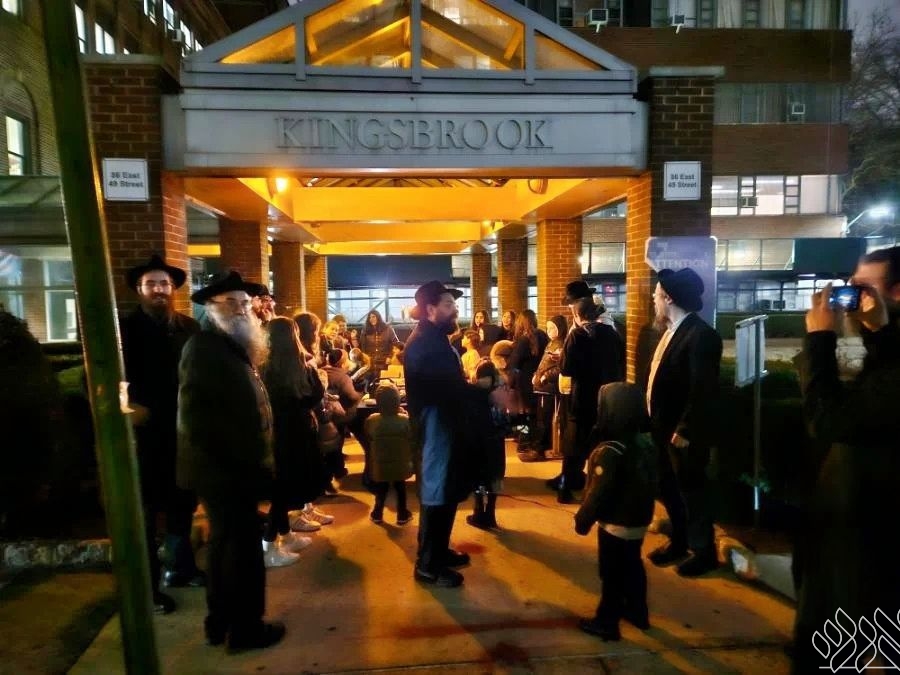
The development came days after a widely covered Chanukah menorah lighting on the fourth night of Chanukah, where hundreds gathered at the corner of Rutland Road and East 49th Street. The menorah was lit by a bochur who had been attacked in an antisemitic assault on the New York City subway while returning from Chanukah mivtzoim just two nights earlier.
The event, titled “A Century of Light,” marked what would have been the shul’s 75th anniversary since the current building was dedicated in 1950, and 100 years of Jewish history connected to the Kingsbrook campus. Men, women, and children stood outside the locked building in the winter cold, holding signs and placards calling for the shul to be reopened.
As reported on Anash.org, community members have been barred from entering the building since March 2020, when it was closed during the COVID-19 pandemic. Unlike others, across New York, the Kingsbrook Shul never reopened, even after the state’s public health emergency officially ended in June of 2023.
As a result of the menorah lighting – especially given that it was lit by the bochur who had been assaulted just days earlier – the event gained significant additional media attention.
*
The Kingsbrook Jewish Medical Center traces its origins to 1925, when Brooklyn’s Jewish community responded to widespread discrimination at Kings County Hospital. This included forged medical records, altered medication orders written by Jewish doctors, and deliberately withheld emergency care from Jewish patients. In one documented case, a Jewish woman died after being refused treatment.
Max Blumberg, a prominent philanthropist, led the effort to establish what was originally called the Jewish Sanitarium for Incurables.
The cornerstone was laid in 1927, with Governor Alfred E. Smith addressing a crowd of approximately 3,000 attendees. The Times Union described the event as “one of the most important in the history of Brooklyn Jewish institutions.” Historical records indicate that over 3,000 Brooklyn Jews contributed funds to establish the hospital.
The shul opened in 1928, and by 1935 had expanded into a 500-seat synagogue open to the public. Hospital membership at the time numbered approximately 5,000 people.
On May 3, 1943, President Franklin D. Roosevelt spoke at the hospital before a crowd of 1,400.
The current standalone shul building was dedicated on March 20, 1950. Isaac Albert, who served as hospital president for 18 consecutive terms, named it the Joseph Chaim Albert Synagogue after his father. The Brooklyn Daily Eagle covered the dedication ceremony, which drew several hundred attendees.
The shul operated as a “free shul,” with no membership fees, and over the past century served both hospital patients and the broader East Flatbush and Crown Heights communities.
In 2018, Paul Rosenfield was appointed CEO of Kingsbrook Jewish Medical Center. Under his leadership, the hospital merged with Brookdale Hospital and Interfaith Medical Center to form One Brooklyn Health. Following the merger, access to the shul began facing new restrictions, including ID requirements and Shabbos-only access.
When COVID struck, the shul was closed along with most religious institutions citywide. However, unlike other houses of worship, it remained locked long after pandemic restrictions were lifted elsewhere.
Last year, One Brooklyn Health even hosted a Gospel Fest on the premises, an event publicly promoted by the hospital, while Jewish requests to hold Yom Kippur services in the shul were denied.
As plans emerged to permanently repurpose and potentially demolish the shul building, Congregation Chaim Albert filed a lawsuit in New York State Supreme Court against One Brooklyn Health System, Inc., seeking to establish a constructive and charitable trust to preserve the building for religious purposes and affirm the shul’s ownership rights.
The complaint argues that One Brooklyn Health “deliberately kept the building closed long after the public health emergency caused by COVID had passed in order to avoid public backlash over removing an active house of worship.”
*
“Some of Brooklyn’s leading rabbis participated in the synagogue’s inauguration 75 years ago,” said Rabbi Yerucham Silber, Director of New York Government Relations for Agudath Israel of America. “We are grateful to Governor Hochul for her efforts to help preserve this historic and meaningful religious institution.”
“Thank you, Governor Kathy Hochul, for intervening to save the historic Kingsbrook Shul,” New York Attorney General Letitia James wrote on social media. “This synagogue has been meaningful to the community for decades, and I am grateful that a treasured piece of Jewish history in New York will be preserved.”
Crown Heights Activist, Rabbi Chanina Sperlin said: “A huge thank you to Governor Kathy Hochul for her incredible leadership in saving the historic Kingsbrook Shul, Congregation Chaim Albert, and to her amazing staff, who are always responsive and helpful, especially throughout this important effort.”
While Governor Hochul’s intervention has halted demolition plans, the shul building remains locked. The sifrei Torah, siddurim, and other sacred articles remain inside, inaccessible to congregants who have davened there for decades.
The Governor’s statement called for “leadership from the hospital and synagogue to find a path forward where both sites can prosper and serve the community,” indicating that negotiations between One Brooklyn Health and the shul will be necessary to determine permanent access arrangements.
The lawsuit filed in July 2024 remains pending in the New York State Supreme Court.
***
Additional historical information and documentation about the Kingsbrook Shul can be found at kingsbrookshul.com.
 COMMENTS


We appreciate your feedback. If you have any additional information to contribute to this article, it will be added below.