




י׳ שבט ה׳תשפ״ו | January 27, 2026
From Phoenix to Purkersdorf, Bochur Traces Long-Lost Photographs
Over a recent break from yeshiva, 13-year-old Menachem Lewis and his father, Yaakov, found themselves in Vienna. They were there with a purpose: to solve a historical mystery regarding the Frierdiker Rebbe, and to visit the places they’d read about but never seen.

For most travelers, a long layover is an inconvenience. For 13-year-old Menachem Lewis and his father, Yaakov, it was a window of opportunity into the past.
Over the recent Chanukah break, Menachem, who was celebrating his bar mitzvah with his father, found himself in Vienna. They were there with a purpose: to solve a historical mystery regarding the Previous Rebbe, and to visit the places they’d read about but never seen.
The Mystery of the “Otwock” Photos
For decades, Chabad historians and archivists have possessed a series of black-and-white photographs of the Previous Rebbe standing outside of buildings and studying Torah in a relaxed setting.
The prevailing theory was that at least some of these images depicted Otwock, Poland, the suburb of Warsaw where the Rebbe had made his home from 1934 until the Nazi invasion of Poland. However, verifying this was nearly impossible. Much of Otwock was decimated by the Nazis during World War II, erasing the architectural evidence needed to confirm the locations.
But Menachem and his father had a different hunch.
Inspired by the life of the Previous Rebbe, who stood up to the Communists, narrowly escaped the Nazis, and immediately set about building up Jewish life in the US, the father-son duo had been studying his travels. They knew that the Rebbe had spent time in Austrian sanitoriums and had gone so far as to access the original architectural plans of the buildings to see if they fit what had been preserved in the photos.
Examining the architectural details in the background of the photos—the railings, the window frames, the sweep of the gardens—they began to suspect these weren’t Polish buildings at all. The buildings in the photo appear distinct, characterized by the Viennese Secession movement and quadratic basic forms. This approach is far less ornamental than the interiors typical of that period.
They had a strong hunch the photos were taken in Austria.

The Discovery in Purkersdorf
While in Israel, the father and son had the pleasure of meeting with R. Uri Kaploun, an elder chassid, who has devoted decades to translating the Yiddish and Hebrew output of the Previous Rebbe.
For the American father and son, it was a rare opportunity to learn about the Frierdeker Rebbe’s teachings, learn about Kaploun’s thoughtful approach to translation, and share their appreciation for his dedication in bringing the treasured texts to life for the English-speaking world, including essays written in Purkersdorf, a town just outside of Vienna.
And just days later, they would be able to stroll in that very same spot, hoping to catch a glimpse of the Previous Rebbe’s stays in the city.

The Previous Rebbe had spent time in two sanitoriums near Vienna, according to Chabad historian Rabbi Aaron L. Raskin, senior editor at Kehot Publication Society and a noted expert in the Previous Rebbe’s works for nearly forty years.
His first stay at Purkesdorf lasted from the end of 1934 to the spring of 1935, with the Rebbe returning to Poland in time for Passover.
That following summer, the Previous Rebbe underwent medical treatments with Dr. Gerson in Ville-d’Avray, near Paris. On his way there, and on his return journey to Otwock in late Elul, he stayed for several days at the sanatorium in Purkersdorf: The then-Jewish-owned Sanitorium Purkersdorf, built in 1904-05 by the architect Josef Hoffmann, offered treatments such as mineral baths, physical therapies, therapeutic massages and physiotherapy.
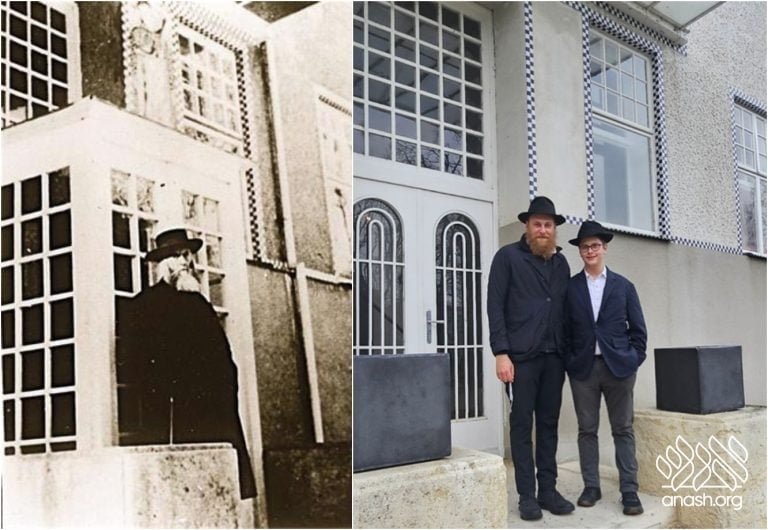
Armed with vintage photos and architectural plans showing how the building had been used nearly a century ago, they stepped onto the sanatorium’s grounds. As they explored, the pieces began to fall into place.
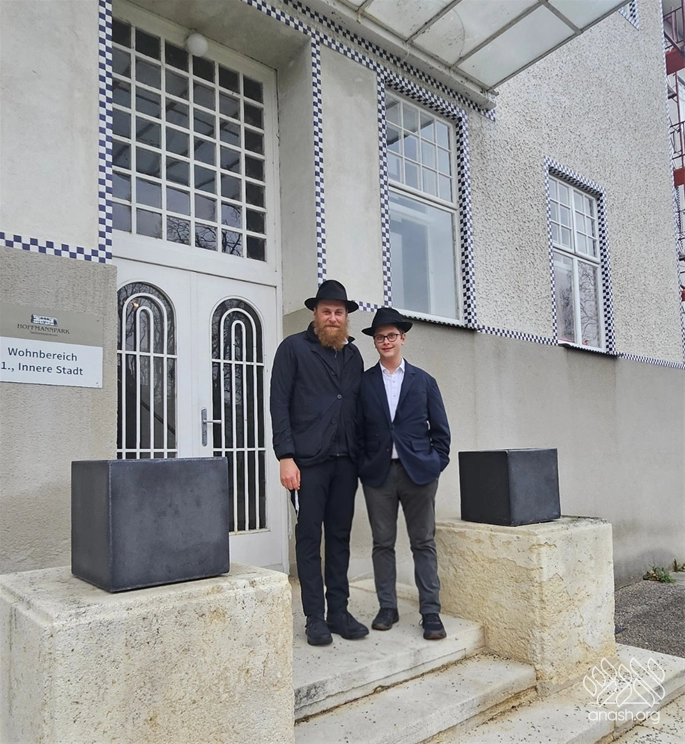
Their hunch was confirmed. Every detail in the old photographs—the rolling black-pine hills, the ironwork, the quadratic tile framing the windows and doors, even the glasswork—lined up perfectly with what lay before them.
“It’s one thing to look at these old black-and-white photos my dad found in library archives and online, but then actually standing in front of the building—with the same tiles and those two cement blocks by the door—and being able to line it up—that was super exciting for me!”

A Significant Historical Find
Following the sharing of this discovery some weeks ago, it has garnered significant attention and acclaim within the archival community. Researchers and historians have expressed considerable interest, recognizing its importance in tracing and contextualizing other historical photographs.
“You wonder why these photos have not been placed until now?” Rabbi Raskin asked. “Identifying these photographs is far less simple than it may seem. Images from this period are rarely straightforward to date or place. We piece together many kinds of evidence — letters, developer stamps, catalog numbers, and architectural or interior details.
“Here, we have no fewer than five photos positively attributed that have confounded us for decades,” Rabbi Raskin continued. “This is a wonderful discovery — one that will allow future publications to present these historically significant images with deeper context and greater clarity.”

 COMMENTS


Thanks very interesting
There are a lot of the pictures labeled from there as well on Rebbe Drives Freirdiker Rebbe photo collection https://www.rebbedrive.com/freirdiker-rebbe
Yasher Koach Menachem and Yaakov! What a tremendous and valuable contribution to Jewish and Lubavitch history.
The Rebbe and Frierdiker Rebbe are surely shepping nachas.
a similar article was published recently in the Yiddish די וואך publication
According to the article this father and son took these pictures 6 weeks ago over Chanukah.
The yiddish paper report was only from a few days ago.
The Frierdiker Rebbe also spent time in Perchtelsdorf near Vienna.