




כ״ו ניסן ה׳תשפ״ו | April 12, 2026
Chossid’s Story Shared at Anne Frank Exhibit in Montana
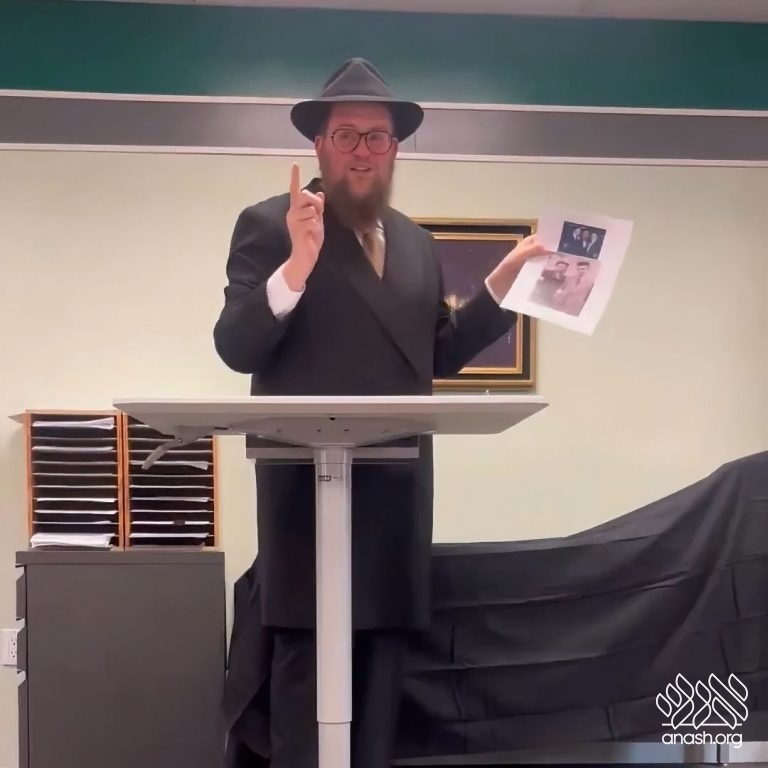
Speaking at the opening of a traveling Anne Frank Exhibit in Whitehall, Montana, Shliach Rabbi Chaim Bruk shared the story of his Zeide, Rabbi Shimon Goldman, and drew a stark connection between the horrors of the past and the dangers of today.

On Chol Hamoed Pesach, the Whitehall Community Library in Jefferson County, Montana, hosted the opening of a traveling Anne Frank Exhibit, with Bozeman’s shliach, Rabbi Chaim Bruk, delivering the opening remarks. He used the occasion to tell the story of a boy from the Polish city of Siedlce who survived the Holocaust and went on to build a flourishing Chabad family in America.
That boy was his Zeide, Rabbi Shimon Goldman.
“He was born on January 1st, 1925,” Rabbi Bruk began. “He was one of six children; he was number four in the family. His parents’ names were Shmuel Zanvil and Menucha Krendel. His siblings were Chana, Leah, Yaakov, Yosef, Tzvi Hirsch, and Chaim.”
“My mother of blessed memory was named Chana Leah for two of his sisters. My daughter Chana Leah is named for my mother, so she carries that name as well. I have a brother named Yaakov Yosef, named for two of his brothers. I have cousins who carry all of these names.”
Every last one of them was murdered by the Nazis. Rabbi Goldman was the sole survivor.
He celebrated his Bar Mitzva at 13 without his parents, on the run. As the 1930s wore on and the situation in the region darkened, the young Goldman understood that any formal goodbye would be impossible.
One day in 1939, at the marketplace in Siedlce, he simply let go of his mother’s hand and ran. “He ran and ran until he couldn’t run anymore, and he went from town to town, village to village.”
He made his way to Tomchei Tmimim in Vilna, eventually joining the group of bochurim who, with visas secured by the legendary Japanese consul Chiune Sugihara, crossed Russia to Vladivostok, passed through Kobe, Japan, and spent the war years in Shanghai’s Jewish quarter. He arrived in the United States by ship in 1946, only to discover that his entire family was gone.
He married Esther Gordon in 1949 and settled in Brooklyn, where he became a fixture of the Crown Heights and Flatbush communities. He ran the Gemilus Chassadim Shomrei Shabbos, distributing roughly a million dollars a year in loans, served on the board of Beis Rivka, and worked as a shochet and kosher butcher.
“Coney Island Avenue between J and K, there was an old sign that said Simon Goldman’s Butcher Shop.” When people came into the shop, Rabbi Bruk recalled, his grandfather would smile, tell them a story of his childhood, give them whatever they were buying, and send them on their way.
Rabbi Bruk spoke warmly about his own decades-long relationship with his Zayde, describing him as his chavrusa from boyhood. Every Shabbos morning, he would walk four and a half blocks down Albany Avenue to his grandparents’ home.
“I’d knock on the door, because we don’t use the doorbell on Shabbos, I’d scream through the mail slot, Bubbe, Zeide, Bubbe, Zeide. She’d hear me from the kitchen, she’d come out, I’d have wonderful foods that I still pay the price for till today, cinnamon buns and cheesecake and tea with milk, and then I’d study every Saturday morning with him. His smile was contagious, he loved meeting people, he loved telling stories.”
“I spent 30-plus years of my life with him.”
Yet the trauma of the churban never fully left. Once a year, on the 12th of Elul, Rabbi Goldman would rise to say Kaddish, not for one person, but for his parents and all five siblings.
“Every year for 60 years, for 70 years, he’d stand up at the podium, and before he could say the first word of Kaddish, Yisgadal v’yiskadash sh’mei rabbah, he’d burst out crying. Imagine standing and saying Kaddish for your entire family murdered for the crime of being a playful kid living in Poland.”
The only physical remnant Rabbi Goldman carried out of Europe was a single photograph of his sister Chana and her fiancé, both wearing yellow armbands. Rabbi Bruk passed it around the library after he spoke. “We don’t know her fiancé’s name. My grandfather never remembered it. That was the only picture that my grandfather managed to get out.”
Outside that one morning a year, Rabbi Goldman did not walk around in grief. He spoke warmly of his Polish childhood, of the neighbors he played soccer with, and the life he once knew. But it was those same neighbors whose betrayal wounded him more than the Nazis themselves.
“The minute the Nazis gave them a little bit of power and the minute they realized, ‘Oh, maybe I can get that Jewish neighbor’s apartment because if they get killed we have free real estate, maybe we can steal their stuff in their home,’ they turned on the Jews in a heartbeat.”
Rabbi Bruk connected that history to the present with unmistakable directness. Born in New York City in 1981, he said he spent his entire life assuming America was different. But October 7 shook that certainty.
“On October 7, 2023, over 1,200 Jews were murdered, slaughtered, tortured in the Holy Land of Israel. And no matter where you stand on the political dial, murder and torture of Jews for being Jews is never an acceptable thing, yet we woke up on October 8th, and suddenly there were voices that were justifying. Maybe the victims are really the reason for why they were victimized.”
He was equally direct about the double standards routinely applied to Jews. “It’s not politically correct to use the word Jews; they found a new invention, they use the word Zionist. You don’t have to like Israel, you don’t have to support everything Israel does, but if you ignore Darfur and you ignore Tehran and Tripoli and Damascus and Nigeria, Ukraine and Myanmar and China, if you ignore the Uyghurs, then you’re not really worried about human rights. You’re primarily worried about Jew hatred.”
He pressed the point further: “If you blame the Jews for being religious and for being secular, if you blame them for being communist but also for being capitalist, if you blame the Jews for your own failures because you didn’t succeed in life and you met a Jew that did, then the Jews are not the problem. Something in your heart may be the problem.”
“I have bad mechanics, I have contractors that do great jobs, I have cashiers that are grumpy. I never said, ‘Oh, there’s a Christian cashier who’s having a bad day.’ And yet if one Jew looks at you the wrong way, it’s not just that person having a bad day; it’s all of the Jews. Lumping us into a group is where it all starts.”
The consequences, he noted, are felt even in Montana. “Here in Montana, I know it’s hard to believe because we celebrate our Second Amendment, but Jewish communities around the state have to pay a lot of money to have our synagogues and our Jewish centers secured with armed guards because we just don’t know what we’re going to be dealing with. It never was that way; it wasn’t that way for at least 15 of the 19 years that I’ve been in Bozeman.”
He urged the audience not to dismiss history’s perpetrators as something other than human. “People like to say the Nazis were monsters, or that Hamas terrorists are monsters. It’s the biggest mistake we make. They’re not monsters. They’re human beings that have been brainwashed to think that it’s a good thing to do.”
“And once we remember that they’re human beings, we must ensure that our communities, small or large, are educated. What are your children listening to? What podcasts are they listening to? Have some idea so you can counter some of the garbage that’s being spewed.”
He tied it back to his Zeide: “My Zeide taught me every day to wake up and not listen to the noise. He cherished life because he knew what the opposite looked like.”
The remedy, he argued, begins locally and costs nothing. “One Jeannie, one library, one Connie, one community at a time, we educate our children, we educate our teenagers, and we educate ourselves. Each of us in this room has the ability to be a beacon of light, not just for Whitehall, not just for Jefferson County, not just for the state of Montana, but for the world. It doesn’t cost money to smile and be kind. It doesn’t take extra effort to show some gratitude and goodness in this world.”
He closed by paraphrasing an Israeli prime minister: “The Jews would rather be alive and disliked than dead and popular. We don’t want the world’s sympathy; we don’t want the world’s condolences. We want the world to shine brightly with goodness and kindness and allow every minority and every human being to live their life freely, happily, to worship as they see fit, with kindness, humility, and gratitude.”
When Rabbi Shimon Goldman passed away in 2016, he left over 100 descendants. He was 91 years old.
VIDEO

 COMMENTS


We appreciate your feedback. If you have any additional information to contribute to this article, it will be added below.