



כ״ב תמוז ה׳תשפ״ה | July 17, 2025
At Last, Israel Transfers Me’aras HaMachpelah Control to Jews
In a long-overdue move, Israel has officially transferred authority of Me’aras HaMachpelah from the Palestinian Authority to the Chevron Religious Council. More than five decades after the liberation of Chevron, this shift in governance is a necessary correction of a decades-old mistake.
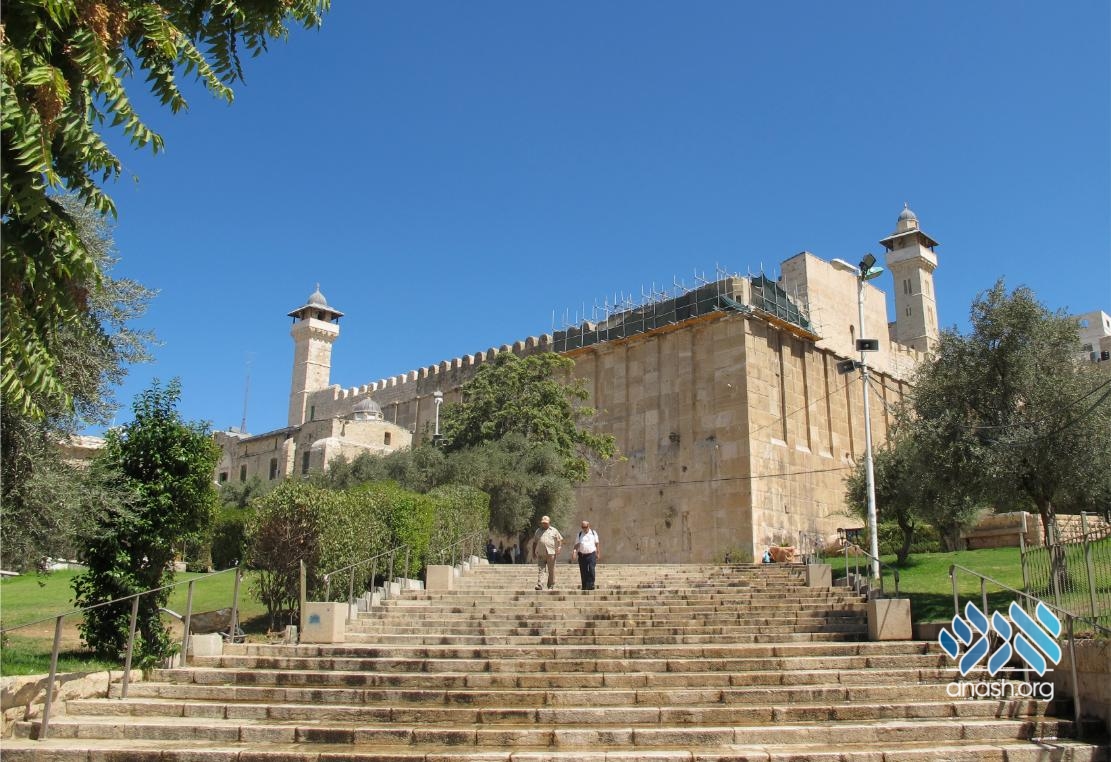
In a long-overdue move, Israel has officially transferred authority of Me’aras HaMachpelah from the Palestinian Authority to the Chevron Religious Council. More than five decades after the liberation of Chevron, this shift in governance is a necessary correction of a decades-old mistake.
By Anash.org reporter
In a move long overdue, Israel has officially transferred administrative authority over Me’aras HaMachpelah in Chevron from the Palestinian-run Hebron Municipality to the Kiryat Arba–Chevron Religious Council. The decision comes after years of failed attempts to carry out critical safety and accessibility upgrades at one of our holiest sites.
Among the long-delayed projects are the installation of a permanent roof over the open-air “Yaakov’s Courtyard,” an advanced fire safety system, and basic restroom facilities – upgrades that were repeatedly blocked due to bureaucratic hurdles and Palestinian opposition. The goal now, according to COGAT, is to “provide shade in the courtyard area for the benefit of all worshippers,” with the work already in advanced planning stages.
For over 700 years, starting in the 13th century under Mamluk rule, Jews were prohibited from entering the actual building and were only allowed to daven outside, stopping at the infamous “seventh step.” After the 5708 (1948) War of Independence, Chevron came under Jordanian rule, and all Jewish access to the city and the cave was completely banned. This remained the status quo until 5727 (1967), when Israel miraculously regained control of Chevron during the Six-Day War.
It was a historic opportunity, but one that Israel sadly squandered when Defense Minister Moshe Dayan handed administrative control of the site back to the Islamic Waqf. While Israel kept military oversight and allowed davening inside the building for the first time in centuries, the Waqf kept authority over the property itself. This meant that even the simplest changes, like replacing a light bulb, adding a tarp, or repairing plumbing, required Waqf approval.
Under the Oslo Accords and the subsequent Hebron Protocol, civil control over most of Chevron, including matters related to the site, was officially handed over to the Palestinian Authority. Israeli bodies kept control over the Jewish-designated section, but even that was governed by a delicate rotation agreement. Despite being under Israeli control, the Waqf still held effective veto power over it.
This dysfunction has had serious consequences. In 5771 (2011), heavy rains caused the temporary tarp covering the courtyard to collapse. Approval for a permanent roof was granted in 5784 (2024) but never carried out. The construction of a ramp and elevator for handicapped access was delayed for decades due to Palestinian objections and was only completed last year, following public outcry and legal battles.
Dr. Noam Arnon, a longtime researcher and advocate for the site, noted that the Waqf maintains full control over the largest and most protected section, while Jewish visitors are relegated to the open, sun-exposed courtyard.
Now, with the transfer of authority to the Kiryat Arba–Hebron Religious Council, long-blocked upgrades can finally move forward. On-site restrooms, a decades-old request, were opened this past Sunday, marking the first in what is expected to be a series of long-delayed improvements.
Shai Glick, CEO of the human rights organization B’Tsalmo, said, “For too long, due to a misguided decision by Moshe Dayan, the site was managed by the Waqf and military authorities. This move finally restores dignity and sovereignty.”
Eyal Gelman, head of the Israeli Chevron city council, noted that planning for a proper roof began more than twenty years ago and was approved back in 5767 (2007), but was never completed. “Since then,” he said, “the suffering and hardship of the worshippers who frequent the holy place has not ended.”
Four months ago, residents and administrators erected a new roof with private funding, only to have it taken down because of Waqf pressure. But now, with the government finally removing the last legal obstacles, Gelman confirmed that the original plan is moving ahead and the roof is expected to be finished in the coming months.
It is important to note that immediately following the miraculous victory of the Six Day War, the Rebbe began expressing deep concern over the Israeli government’s failure to assert full and permanent sovereignty over the territories it had just reclaimed – especially holy sites such as Chevron and Me’aras HaMachpelah. Instead of firmly establishing Jewish control, the government sought to appease international pressure and started bargaining with the Arabs – offering concessions that weakened both Jewish security and our historical and moral claim to the land.
At a farbrengen for Shabbos Chayei Sarah in 5746, the Rebbe addressed the absurdity of Jews being denied full rights and access to places like Me’aras HaMachpelah – especially since it was the first piece of land in Eretz Yisrael purchased by Avraham Avinu with full price. Any concession over such sites was a dangerous recognition of the religious claims of others, weakening our own legitimacy and rights in the eyes of the world.
Additionally, the Rebbe criticized Israel for often failing to assert its historical and deep connection to the land with pride, while other nations loudly proclaimed theirs.
It is fitting to conclude with the Rebbe’s words to Israel’s ambassador to the UN, Mr. Yaakov Herzog (father of current President Yitzchak Herzog). After urging him to declare at the UN General Assembly that Chevron belongs to Am Yisrael, the Rebbe said that although the Israeli government had already decided to give up the city, such a public declaration before the nations of the world might delay the decree by ten, twenty, or thirty years and by then, Moshiach will have arrived, and we will have all parts of Eretz Yisrael.
It has taken more than five decades since the liberation of Chevron for this long-overdue shift in governance to finally happen. But this decision marks a necessary correction of a decades-old mistake.
 COMMENTS


Will kever yitzchok finnaly be fully open to yidden all year round?
As long as it is still a mousqe, with those arabic letters kver the avos matzeivos, they are just putting up a show, while still giving it to the arabs