



כ״ד תמוז ה׳תשפ״ה | July 20, 2025
A Dollar of The Rebbe, a Gemach, and Twin Boys
“One of the tickets had won a dollar from the Rebbe. We couldn’t believe it. … If we can’t help him medically, then we need to help him spiritually. … I sat there stunned. Did the Rebbe somehow know that I had started a gmach?”
“One of the tickets had won a dollar from the Rebbe. We couldn’t believe it. … If we can’t help him medically, then we need to help him spiritually. … I sat there stunned. Did the Rebbe somehow know that I had started a gmach?”
By Yudi Hercenberg
When my wife, Simcha, was pregnant with our twins, I spent most of her birthday with her. As the day was ending, I had to catch a flight for a business trip to California. While I was in the air, she texted me that she wanted to give tzedaka before sunset, since it’s a custom to give tzedaka on your birthday. She sent me a link to a fundraiser for Bonei Olam, where you can select (by code) any couple you want to support.
From what I understand, once a couple is fully funded, they can be granted an IVF treatment.
I asked Simcha if she knew who any of the people were behind the codes. She said no. So I asked her, “Do you want to spread an amount across multiple couples, or would you rather help one couple?” She told me to choose one. I found the couple with the lowest amount raised – about $300 – and I donated $24,700 to bring them to their $25,000 goal.
About a month later, I attended a charity event for another organization, Yaldei Shluchei HaRebbe. While I was there, I met a shliach who happened to be the brother of a close friend of mine. I mentioned to him that his brother had once given me the only dollar of the Rebbe I’ve ever had. He gave me a bracha right then and there that I should merit to receive another dollar if the Rebbe very soon.
Two hours later, as I was driving home from the event, I got a message asking me to jump on a three-way call with my wife and a woman from our community. We got on the phone, and the woman told us that because of the donation we gave to Bonei Olam on Simcha’s birthday, we had been entered into 137 raffle tickets and one of the tickets had won a dollar from the Rebbe.
We couldn’t believe it.
We decided right away that this dollar would be present in the delivery room for the birth of our twins – especially since we received it by trying to help someone else bring a child into the world.
As Simcha neared the end of her pregnancy, the doctors grew concerned. Baby B was absorbing most of the nutrients, and Baby A wasn’t growing fast enough. They made the decision to deliver the babies about a month early.
Baby A was born crying, tiny, and exactly as expected. The doctors had warned us in advance that he’d likely need to go to the NICU due to his size. But they weren’t concerned at all about Baby B. He was a healthy weight, and everything seemed fine.
But when it was time for Simcha to deliver Baby B, we hit a complication – he was breech. The doctor tried to turn him but couldn’t. After ten minutes of attempting different maneuvers, the doctor delivered him by his feet.
Baby B arrived silent. Not breathing. Not moving. No sound. No signs of life.
Our hearts dropped. We thought we had just experienced every parent’s worst nightmare.
The medical team rushed to grab a CPAP machine and began resuscitation immediately. Over 20 professionals were packed into that tiny operating room, each focused on doing their part to save Baby B and protect Simcha.
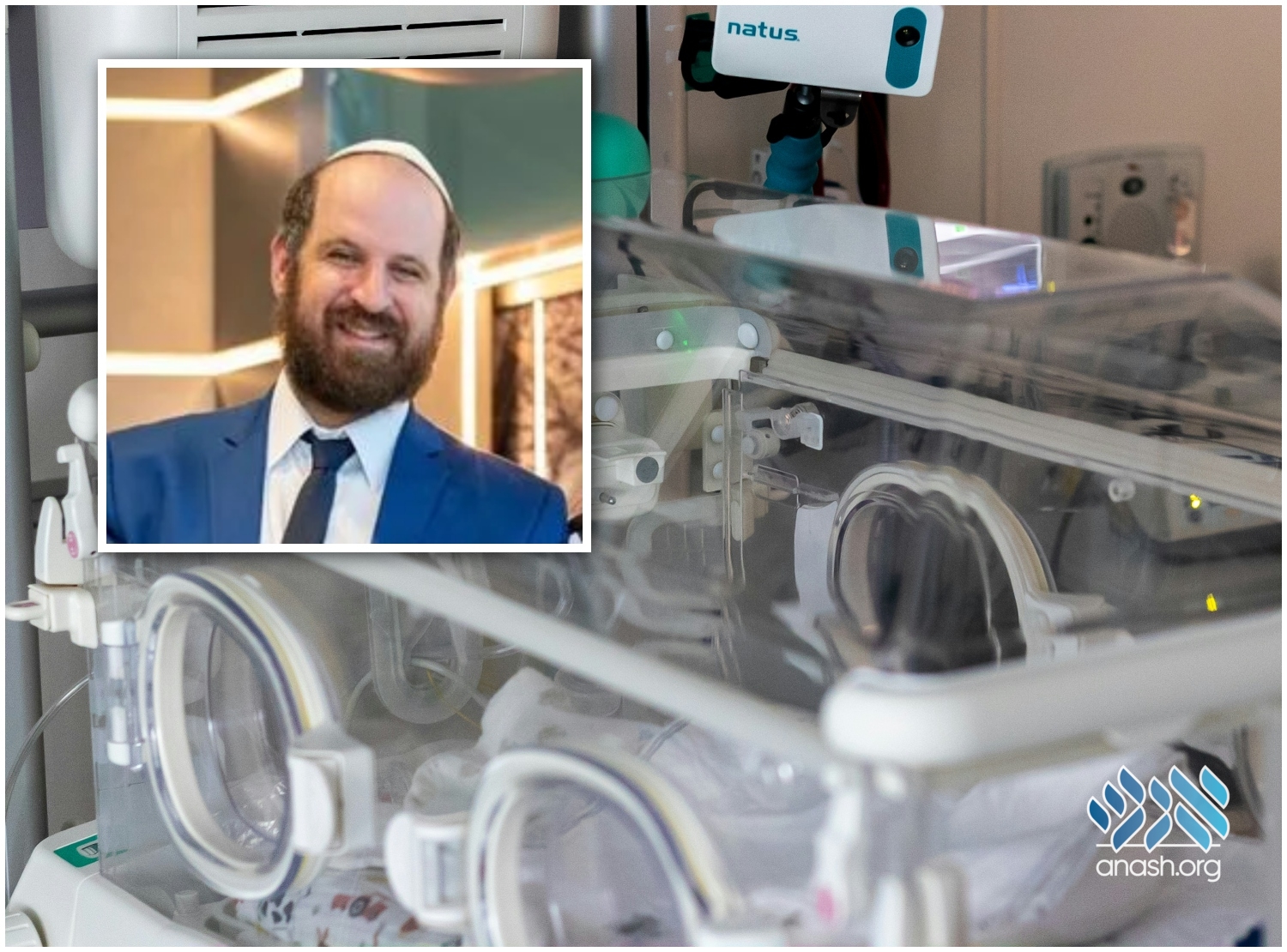
We weren’t allowed to hold Baby B for the first 48 hours. He was in the NICU under intensive care. For the first three days of his life, he was on breathing machines. When they were finally removed, we thought: maybe he’ll come home now. After all, his weight was good.
But then the doctors told us he had bradycardia – a condition where the heart randomly stops beating. Every time his monitor went off, someone had to rush in, pick him up, and jostle him to get his heart going again.
They told us that if he could go five to seven days without any episodes, he could go home.
But we couldn’t even get through one day. Most days, he had multiple episodes.
After three full weeks of NICU visits – every day, all day – and with Baby A already at home, we began reaching out to every specialist we could find. But no matter who we spoke to, the answer was the same: there was nothing medically that could be done.
We were searching high and low for answers, desperate to do something – anything – to help him.
Eventually, I turned to Simcha and said, “If we can’t help him medically, then we need to help him spiritually.”
First, I went back to the hospital and placed the dollar from the Rebbe in Baby B’s crib.
Then, when I got home, I told Simcha that I wanted to fly to New York to go to the Ohel. She didn’t want me traveling, given everything we were going through, so she suggested I send an email to the Ohel instead. She also recommended that I sing a niggun, read a sicha, and open an Igros Kodesh.
I had never opened an Igros before. To be honest, I was a little skeptical. But I agreed to do it.
I opened to a letter that said:
“To devote some additional time to Torah study – over and above your regular studies…..To make a special effort in the matter of Tzedoko, one of the highest forms of which is Gemilus Chasodim – to help friends and others who could do with a free loan. This means that every one of you, in your classroom or school, should join together to create a Gemilus Chesed (Free Loan) Fund – out of your pocket money. And if such a Fund is already in operation – to expand it by additional contributions and by making it available to a greater number of people that can benefit from it.”
I sat there stunned.
Did the Rebbe somehow know that I had started a gmach?
And not only that – but he was telling me that if I already had one, I should expand it?
I was blown away.
Right then and there, I made a few commitments: I would expand the gmach and make it as big as I possibly could. I would expand my learning. Since the letter was written to children and focused on children fulfilling the mitzvah of learning Torah and Tzedaka, I immediately called Rabbi Shuey Biston, a close friend who runs the local Camp Gan Israel and we went around to every bunk in the camp with a tzedaka box and $1 bill for each child. Over 400 children gave $1 to tzedaka that day.
And from that moment on – Shmuel Peretz’s bradycardia disappeared, and he had his Bris together with his older brother, Binyamin Zev, exactly one week later.
Call it what you want. But for me, this experience made one thing incredibly clear:
Hashem wants us to stretch beyond our comfort zones – to take action, even when it feels impossible.
I had already felt proud of what the gmach had accomplished. The gmach had lent out millions of dollars. I thought it was a success.
But the Rebbe was telling me: If this is your mitzvah, make it bigger.
Mr. Yudi Hercenberg is a Senior Managing Director at Walker & Dunlop. He is also the President of Hercenberg Mitzvah Mission, a non-profit that focuses on empowering laymen to be leaders by spreading yiddishkeit and Mitzvos in their communities.
 COMMENTS


❤️❤️❤️
Thank you for publishing this amazing story. We can each learn so much from it.
Did you ever find out who you helped with Bonei Olam?
Yes!! We actually got a letter in the mail about a year later letting us know that the treatment was successful!!! And they told us a little bit more information about the couple. We didn’t actually meet the couple or know their name, but it was good to hear that it actually went through!
Wow!
What an amazing story, such stories really infuse people with more Emunah in hashem and shines a ray of hope for so many who are still looking for where to turn for a nes in their own lives.
is there a way to get in touch with the writer to see if he’s willing to be interviewed professionally to spread this story to a wider crowd outside of chabad?