




ל׳ שבט ה׳תשפ״ו | February 16, 2026
$3B Sale of Israel’s Main Shipping Company Revives Historic Saga
Israel’s primary maritime carrier, ZIM, is reportedly set to be sold to German shipping giant Hapag-Lloyd in a hotly-debated deal valued at over $3 billion. The agreement marks a major shift in Israel’s shipping industry and could revive a decades-old halachic saga led by the Rebbe, who campaigned against Shabbos travel on ZIM-owned ships.
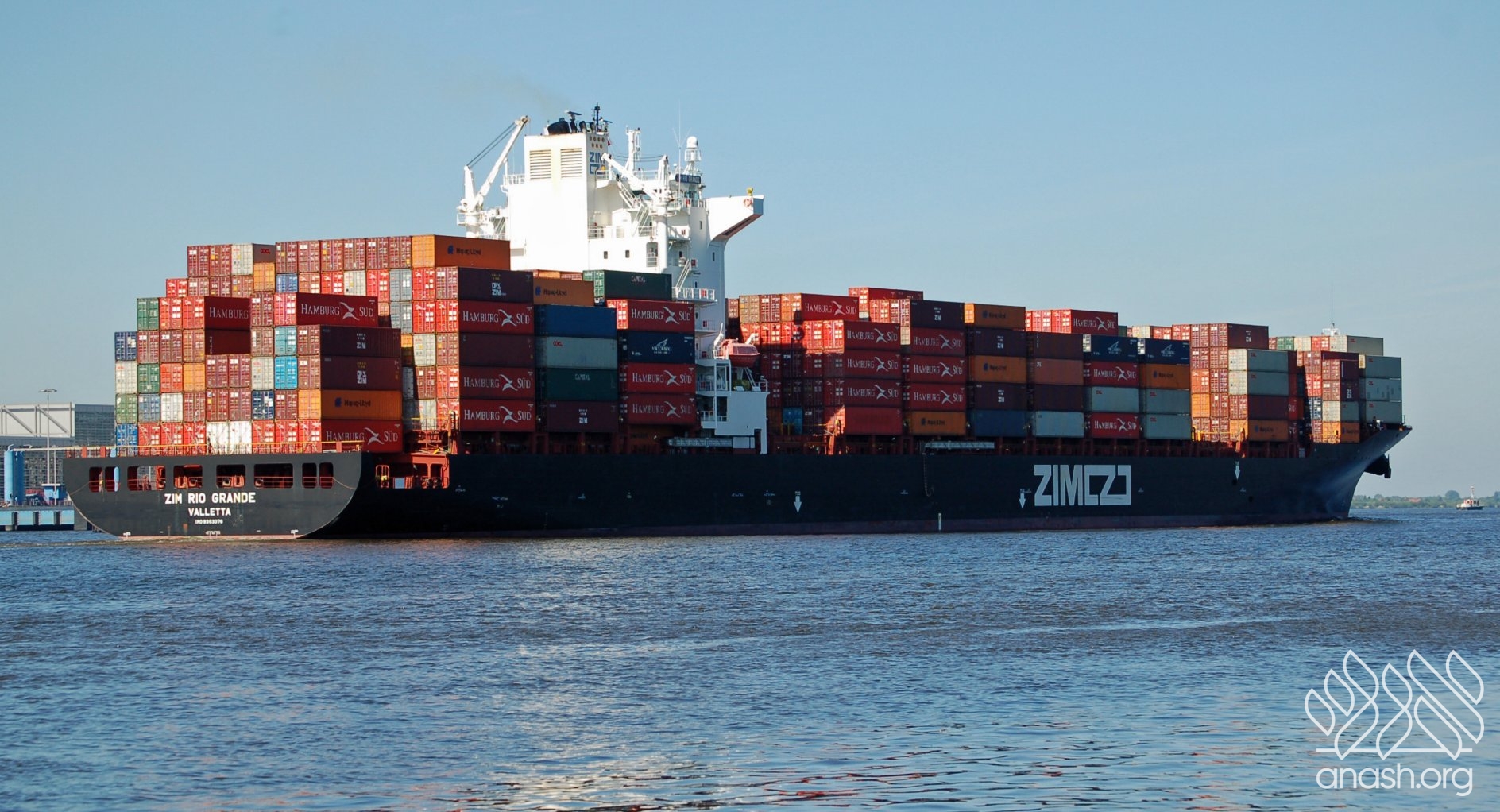
Israel’s primary maritime carrier, ZIM Integrated Shipping Services, is reportedly set to be sold to German shipping giant Hapag-Lloyd in a deal valued at more than $3 billion. The agreement would mark one of the most significant changes in the history of Israel’s shipping industry and revives a decades-old halachic saga and campaign led by the Rebbe against chillul shabbos by this very company.
For decades, ZIM has served as Israel’s main international shipping line, transporting goods to and from ports around the world and functioning as a strategic economic lifeline. Beyond commerce, the company has long held symbolic importance as a national enterprise tied closely to Israel’s security and independence, ensuring supply routes even during times of war.
According to reports, the deal is unusual, with Hapag-Lloyd taking control of ZIM’s global operations, FIMI retaining certain Israel-based activities, and the government’s “golden share” ensuring key management remains in Israel to maintain maritime readiness and strategic oversight during emergencies.
The surprise sale sparked heated debate in Israel, catching officials off guard and prompting an urgent review of potential security and strategic implications. Transportation Minister Miri Regev immediately instructed an assessment of whether the state could intervene using its “golden share.”
The reported sale revives a historic saga led by the Rebbe. Decades ago, the Rebbe led a campaign concerning the disgraceful chillul Shabbos that was taking place aboard the ships of “Shoham,” a subsidiary company of Israel’s largest shipping firm, ZIM Integrated Shipping Services.
At the time, ocean liners were the main link between Israel, Europe, and the United States, and many routes inevitably crossed Shabbos at sea. Israeli vessels operating across international waters created a situation in which a company that was Jewish and state-owned was inevitably an unavoidable case of chilul Shabbos.
ZIM representatives claimed that during Shabbos the ships sailed on “automatic” mode, with all instructions and commands set before Shabbos began. The Rebbe rejected these arguments outright, explaining repeatedly that based on his own engineering knowledge, together with his own examination of how ships operate, it was clear that a vessel cannot sail for an entire day without active intervention from the crew.
The Rebbe went further, outlining precise technical details of the continuous operations that must be performed and cannot function automatically. The Rebbe also proposed a practical solution – that the ship dock at one of the ports along the route for the duration of Shabbos.
Working both privately and publicly, the Rebbe addressed the matter passionately and repeatedly to raise major awareness, reaching out to leading rabbonim and public figures, and pressing shipping companies to find practical solutions.
The Rebbe delved into the technical details of maritime operation, addressed attempted justifications, encouraged efforts to find solutions that would prevent Shabbos operation under Jewish ownership, and urged frum Jews to avoid such travel, using public pressure to encourage change.
The debate drew wide attention, and many attacked the Rebbe for not supporting the Israeli-owned company, instead advising people to travel with non-Jewish companies.
In response to those who supported traveling on ZIM-owned ships in order to help provide Jewish livelihoods, the Rebbe replied: “Anyone who seeks to help fellow Jews through matters that involve an aveirah, especially when connected with chillul Shabbos, is comparable to someone attempting to extinguish a fire with gasoline”.
In the early months of 5717 (1957), ZIM was concerned that a sweeping court ruling could lead to enormous financial losses and issued a special letter clarifying that the operation of Israeli ships was largely automatic, and that the intervention of sailors and engineers would only be necessary in cases of life-threatening emergencies.
However, this explanation did not satisfy the Rebbe, as the company’s letter did not provide a full account of all the tasks involved in operating a modern ship – specifically, which actions the ship performed automatically and which required human intervention that could constitute a violation of Shabbat.
The Rebbe’s opposition to Jewish sailors operating ships on Shabbos reached the newspapers. ZIM sought to address the controversy through professional expertise.
On the 9th of Sivan, 5718 (1958), the chief engineer of the ship Tzion, Mr. Y. Frankel, published a lengthy professional opinion. His conclusion was that everything was mechanized and automatic, and any operations that did require human intervention could either be completed before Shabbos or postponed until after it.
Alongside this clarification, the company noted that Engineer Frankel had fourteen years of experience working on ships.
Nevertheless, his statements did not satisfy many in Eretz Yisroel, and several engineers disagreed with Frankel’s opinion – not claiming he had made an error, but suggesting that he had deliberately omitted the full truth. The issue caused a major stir within the Jewish community, both in Eretz Yisroel and abroad.
The Rebbe wrote a letter in English to Engineer Frankel, presenting a series of detailed technical questions. In the meantime, Frankel left his post, and the questions were forwarded to another expert, who avoided the Rebbe’s probing inquiries with a diplomatic response: “I have nothing to add to the precise answers of Engineer Frankel.”
The Agudas Harabbanim bulletin in the United States requested that the Rebbe’s position be published clearly. At their request, the Rebbe’s secretariat sent several letters on the matter, which were published in the Tammuz 5718 issue. These letters marked the beginning of a prolonged discussion on the subject, which resonated throughout Eretz Yisroel.
The issue became one of the most discussed halachic subjects of its time.
Over the following years, the Rebbe continued writing extensively on the matter. Eventually, the voyages became unprofitable as air travel replaced trips by ship, and the line to the United States was discontinued.
More than sixty years later, it seems that this long saga may have finally come to an end.
If ownership of ZIM’s international fleet shifts to a non-Jewish corporation, the halachic landscape could change significantly. Concerns surrounding Jewish ownership and public Shabbos activity may be greatly reduced once control and profits are no longer in Jewish hands.
At the same time, many questions remain. Jewish employees will likely still be involved in management and operations, especially in the early stages. Israeli stakeholders may retain partial control through special shares, and some ownership interests could still be held by Jewish investors.
Each of these factors carries potential halachic implications that will need to be carefully analyzed and remain to be determined.
 COMMENTS


Where did Lubavitcher Rabbonim say it is forbidden to ship containers with zim? Who said this is the same as passenger boats?
“and urged frum Jews to avoid such travel,”
Only frum Jews?
Wow! This is a huge chiddush. וילחום מלחמת ה’….. וינצח!!