




א׳ אלול ה׳תשפ״ה | August 25, 2025
100 Years of the Luach Colel Chabad
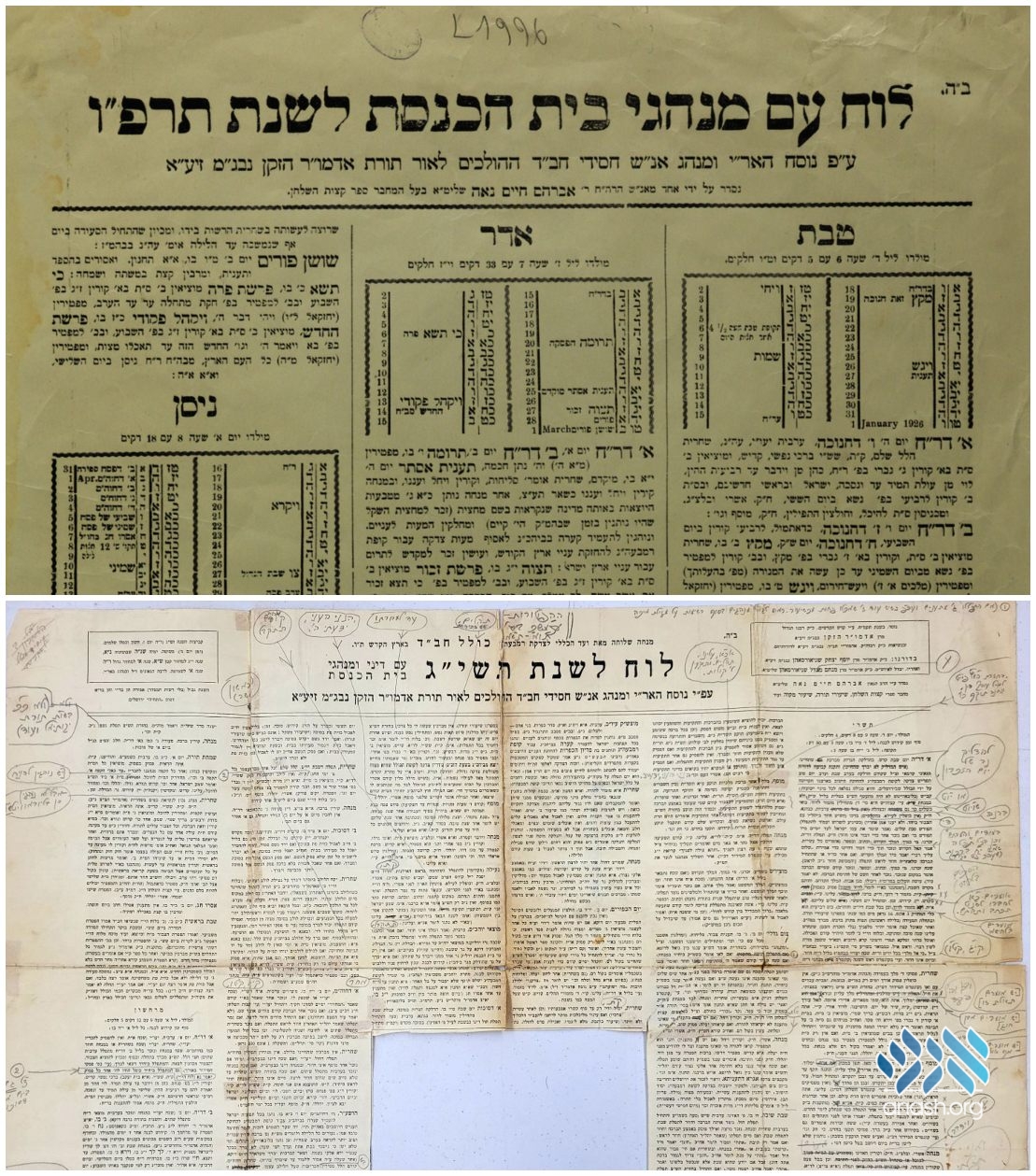
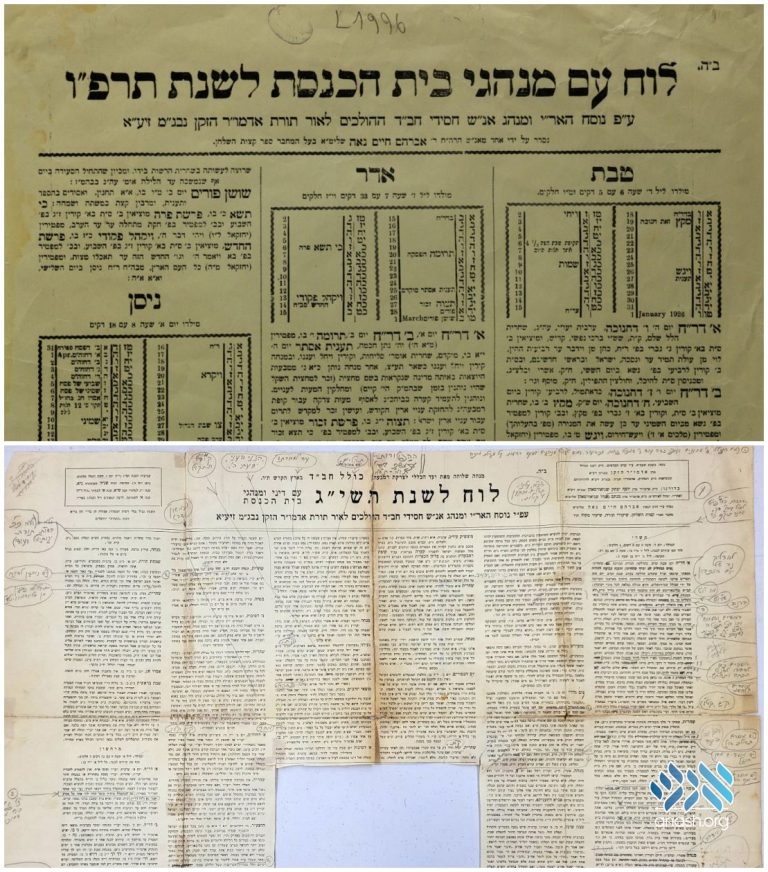
Rosh Hashanah 5786 (2025) marks an important milestone in Chabad Chassidic history. 100 years ago, the famed classic Luach Colel Chabad, based on the customs of the Alter Rebbe, was first published, and throughout that entire century it has been continued annually.
Rosh Hashanah 5786 (2025) marks an important milestone in Chabad Chassidic history. 100 years ago, the famed classic Luach Colel Chabad, based on the customs of the Alter Rebbe, was first published, and throughout that entire century it has been continued annually.
Rosh Hashanah 5786 (2025) marks an important milestone in Chabad Chassidic history. 100 years ago, the famed classic Luach Colel Chabad, based on the customs of the Alter Rebbe, was first published, and throughout that entire century it has been continued annually.
From its beginning, the Luach Colel Chabad has been the Chabad Chassid’s constant companion. Arranged according to the yearly cycle, detailing the laws and customs for every occasion based on the rulings of the Alter Rebbe, the Luach has become an inseparable part of the daily and yearly agenda of the Chabad household.
On the King’s Table
The Luach Colel Chabad was especially dear to our Rebbe, and it was a constant fixture on his desk. The Rebbe also spoke publicly of its importance, such as in the Farbrengen of Rosh Hashanah 5752: “Through carefully reading of these calendars, such as the Luach Colel Chabad (in either of its formats —as a wall calendar or a booklet), which contains the relevant customs and laws, one can easily find these laws. It is thus recommended that everyone peruse these calendars and engrave in his mind the laws relevant to these days, since sometimes, when a question arises, it is at a time when we may not interrupt (the prayers) to ask, or there is no competent authority to ask; sometimes, indeed, one may not know that there is something to ask… The (publishers of such calendars) deserve our thanks.”
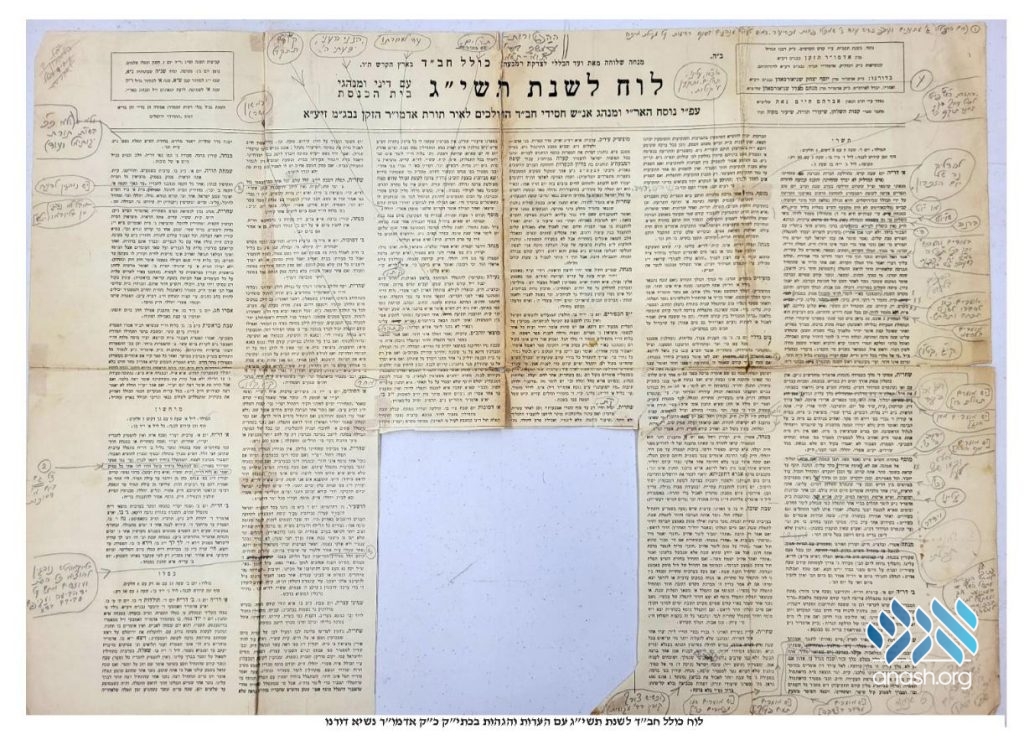
The Rebbe also added corrections to the calendar in his holy handwriting. See pullout, showing a preprint copy of the calendar of 5713 (1952–3), which was sent to the Rebbe and to which he replied with extensive edits.
The Rebbe gave great weight to the customs and halachic conclusions appearing in the Luach, and often stated that they should be followed in actual practice. As an example, on Shabbos Chanukah 5729 (1968), when the first day of Rosh Chodesh Teves was on Shabbos, the Rebbe delivered a detailed analysis of how the haftorah should be recited, concluding that actual practice should be as per the Luach Colel Chabad: first the haftorah of Shabbos Chanukah, then certain verses from the haftorahs of Shabbos Rosh Chodesh and Machar Chodesh (see p. 78).
For another example, R. Boruch Pariz, a prominent chassid in Kfar Chabad who served as the shofar-blower in the Beis Menachem shul there, once asked the Rebbe about the correct reading of זכר in Parshas Zachor. In reply, the Rebbe noted that he had been previously asked about this, and that his decision can be found in the Luach Colel Chabad (see p. 86).
R. Tuvia Blau shlita reports that the Rebbe went still further. In Tishrei 5723 (1962), in a yechidus during which R. Blau asked the Rebbe for rules for day-to-day living, “the Rebbe said explicitly that we, Chabad chassidim, must follow Hayom Yom, the listings (of customs) compiled by the Previous Rebbe, and the Luach Colel Chabad.”
The Luach’s Beginnings
The story begins with R. Avraham Chaim Naeh (5650–5714 / 1890–1954), one of the leading Chabad Chassidim in Jerusalem, and a distinguished posek (halachic authority) who served for many years on the Beis Din of the Edah HaCharedis of Jerusalem.
Some one hundred years ago, shortly before the High Holy Days, he walked into the offices of Colel Chabad, in the Meah Shearim neighborhood of Jerusalem, where his father, R. Menachem Mendel Naeh, was an administrator. R. Avraham Chaim was surprised to see officials of the Colel preparing copies of the Luach Eretz Yisrael for mailing.[1] Each envelope, with a copy of that Luach and a letter of blessing for the new year, was addressed to one of Colel Chabad’s worldwide supporters.
Disturbed at the sight, R. Naeh voiced his objections: “This Luach follows the practices of the Perushim; in many shuls these have superseded the halachic decisions of the Alter Rebbe. How can you, with your own hands, bring about the same thing in the shuls and homes of the Chabad Chassidic brotherhood?”
The Colel employees nodded in agreement, but sighed, “So what can we do? We have no Luach of our own, so we have no choice but to send this one; our faithful supporters need an annual Luach with the halachic times of day. Take this envelope, for example: it is addressed to the gabbai of a Chabad shul who requested it in order to know how to run his shul, and we must send him something.”
There and then R. Avraham Chaim decided to undertake the significant task of compiling a Luach of Chabad chassidic customs, following the halachic rulings of the Alter Rebbe and his successors, the Rebbes of Chabad.
That very year, 5685 (1924–5), the administration of Colel Chabad published their first calendar, under the title:
A calendar for the year 5685
From the Chabad chassidic communities in the holy lands: Jerusalem, Hebron, Safed, Tiberias, Jaffa and Haifa
The introduction to the Luach summarized the previous year, 5684, as “one of the most terrible years for the Jewish people everywhere. To the sea of tribulations and the waves of disaster that the Jewish nation undergo throughout their bitter exile, this difficult year has added powerful storms that inundated us. It was also a stressful and dreadful year for Eretz Yisrael, and for our community of the Chabad chassidim; the poor, the Torah scholars, the widows and orphans, all suffered and sighed.”
Yet their review also included a bright spot, the rapprochement of the Chabad community’s disparate factions under the umbrella of the Colel, “with all of the separate parts coming together into one bloc, one all-encompassing community, full of Divine blessing in Torah and fear of G-d.”
That pioneering Luach contained the times of the molados and the calendar dates for 5685, followed by Colel Chabad’s bylaws outlining their efforts on behalf of their generous donors and supporters, such as regular prayers for their wellbeing, and Torah study and the recital of Kaddish for their souls after their passing. It next listed the names and yahrtzeits of the deceased wardens and supporters of the Colel around the globe, for the elevation and merit of their souls.
The Luach of Customs
Rosh Hashanah 5686 (1925) saw R. Avraham Chaim’s vision and labor come to pass: the first issue of the Luach Colel Chabad with the Alter Rebbe’s decisions and customs, as well as Chabad customs for the entire year, was published.
R. Naeh invested much effort to ascertain the customs of the Rebbes of Chabad, to research numerous works of halachah and minhag, and to consult elder Chabad rabbis and chassidim about unknown customs.[2]
The Luach was warmly received by Chabad chassidim in Eretz Yisrael and worldwide, filling a heretofore unserved need. As noted above, for lack of any alternative, they had generally been using R. Tucazinski’s popular Luach, which followed the Perushim customs. R. Shlomo Yosef Zevin describes the situation at the time: “Chabad had no shul calendar of its own. They had to make do with the ‘Ashkenazic’ Luach, though they always kept in mind that ‘we cannot rely on that Luach,’ ‘it is a misnaged (opponent of Chassidus)’…”[3]
There was much uncertainty at the time among Chabad chassidim about customs and practices pertaining to less-frequent occasions. The Luach Colel Chabad thus immediately filled that vacuum, and naturally was welcomed with open arms by chassidim and given a place of honor in the shul.
One example of how urgently the Luach was needed: The Rosh Hashanah and Yom Kippur prayers feature piyutim, liturgical poems inserted at various points in the service. Machzorim differ widely in which are to be recited and which are omitted. While Chabad chassidim had oral traditions on the subject, there was considerable confusion as to their practical implementation. R. Naeh clarified the matter in the Luach, and this has since become the universal Lubavitch custom.
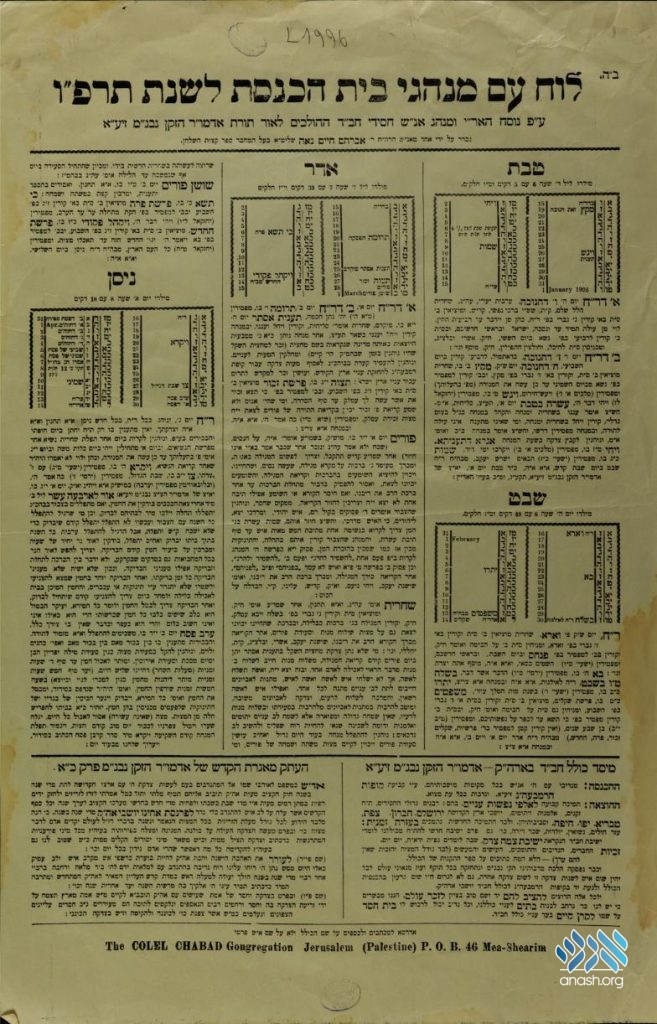
The Luach was first published as an oversized wall calendar, which was promptly hung on the walls of Chabad shuls everywhere, becoming in each one a focal point consulted alike by rabbis, gabbaim, and laymen. Later, Colel Chabad began publishing it for individual use too, as a conveniently sized booklet.
A Heavenly Portent
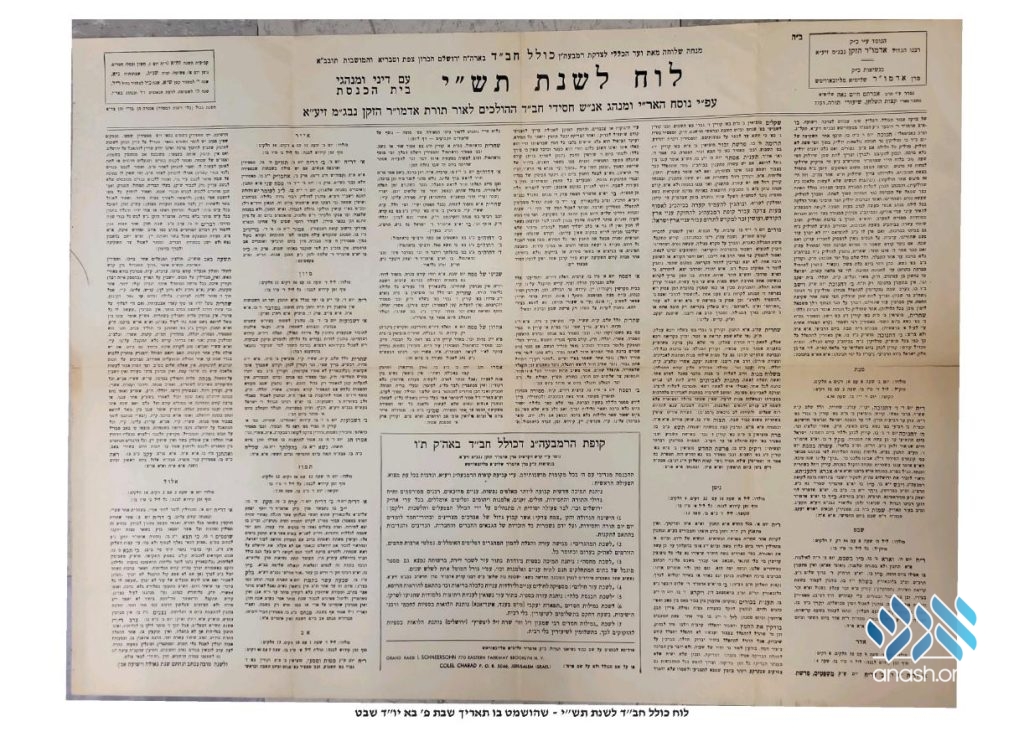
At the end of the 5709 (1949) R. Naeh prepared the Luach for the coming year as usual. Somehow, seemingly unaccountably, the entry for Shabbos Parshas Bo (which that year fell on 10 Shevat) was missing (see pullout).
Later, it turned out that this was the very day on which the Previous Rebbe passed away. R. Avraham Chaim himself wrote of this in his book Shiur Mikveh, after describing how he had measured the Previous Rebbe’s Kiddush cup as part of his research into the size of the halachic measure of volume known as a reviis:
He ascended to the Heavenly realms on the holy Shabbos of Parshas Bo, 10 Shevat, of this year 5710. In the Synagogue Luach of Chabad Customs this Shabbos was omitted in print, and it was (retrospectively) seen as a portent.
R. Naeh’s daughter related:
There were several very responsible people who had proofread the calendar before it went to print. Despite this, the Luach shows Shabbos Parshas Va’eira on 3 Shevat, followed by Shabbos Parshas Beshalach on the 17th, with the Shabbos of 10 Shevat completely missing from the Luach. How is it that not one of the copyeditors noticed this mistake? I myself merited to be one of those who checked the proofs; granted that I overlooked this omission, but how could my father himself have skipped this date by Divine Providence? Only after Yud Shevat did we realize the import of this mistake.
The Luach Continues On
R. Avraham Chaim Naeh passed away in 5714 (1954). His son, the gaon R. Boruch Naeh of blessed memory, took on the task of compiling the Luach year by year, and also added numerous valuable notes to his father’s great work. Also worthy of note: after compiling the Luach for 5716 (1955–6) R. Boruch sent it for review to the Rebbe, who contributed several comments.
Since R. Boruch’s passing in 5756 (1995), his son R. Yosef Yitzchak shlita (named for the Previous Rebbe) continues this sacred work.
Year by year, for 100 years without interruption, the administration of Colel Chabad has distributed every year thousands of copies of the Luach to their friends and supporters throughout the world. As time has gone on, they have improved its production values and layout, added useful appendices (a study calendar for the Rambam’s Mishneh Torah and Sefer Hamitzvos, and a list of significant Chabad anniversaries), and opened its treasures to English-speaking Anash in the United States and elsewhere.
As we conclude the first century of the publication of Luach Colel Chabad, we plead with G-d that He protect His people in the Land of Israel and everywhere, and that just as He has helped us reach this milestone, so may He bring us to the ultimate milestone: the end of our long and searing galus, the arrival of our righteous Moshiach, and the rebirth of “those who dwell in the dust” and our reunion with them in body and spirit, first and foremost among them our dear Rebbe.
To order the luach, click here.
[1]. That Luach was first published by R. Yechiel Michel Tucazinsky in 5665 (1904–5). It incorporated halachic decisions and customs followed by the Perushim communities (founded by disciples of the Gaon of Vilna) in the Land of Israel, and also included the halachic times of day as determined by R. Tucazinsky’s own methods (see footnote 3 below).
[2]. In preparing the Luach, R. Avraham Chaim was also able to draw on his experience in putting out an earlier calendar in 5675 (1914–5). For a time he had served as rabbi of Samarkand, Bukharia (having been sent there by the Rebbe Rashab), and was thus able to write up the practices for the entire year in the Bukharian language for that community.
[3]. R. Naeh’s disagreements with R. Tucazinsky extended also to the time of alos hashachar (halachic dawn). In 5699 (1938–9) he published a series of essays in the Kol Yisrael newspaper, questioning why R. Tucazinsky had decided that the interval from alos hashachar to sunrise is 1½ hours, when Rambam and the Alter Rebbe maintain that it is two hours.
 COMMENTS


We appreciate your feedback. If you have any additional information to contribute to this article, it will be added below.